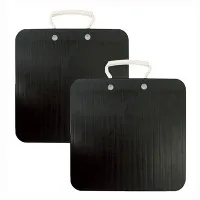
The black leg pad belongs to a type of engineering plastic sheet, which mainly utilizes its pressure bearing capacity in practical applications and can withstand enormous pressure. So how much do you know about its impact resistance? How about its impact strength?
The impact strength of this black leg pad is relatively good among all engineering plastics, with an impact strength of about 2 times that of impact resistant PC, 5 times that of ABS, and more than 10 times that of POM and PBTP. The impact resistance is so high that it is difficult to fracture using the usual impact testing methods. Its impact strength increases with the increase of molecular weight, reaching a peak at a molecular weight of 1.5 million, and then gradually decreases as the molecular weight continues to increase. It is worth pointing out that it can also maintain excellent impact strength in liquid nitrogen (-195 ℃), a characteristic that other plastics do not have.
The black leg pad is mainly used as a pad under the support legs of construction machinery, providing good protection. Therefore, regarding the outstanding performance of the black leg pad, let me explain in detail:
A. Low friction coefficient: Due to its waxy substance, it has good self-lubrication, low flow resistance, and saves energy.
B. Non sticky: With high surface tension and low friction coefficient, it is not compatible with common substances and is therefore less prone to adhesion and scaling.
C. High wear resistance: Due to its molecular structure, its wear resistance is higher than that of ordinary metal plastic products, which is 6.6 times that of carbon steel, 5.5 times that of stainless steel, 27.3 times that of brass, 6 times that of nylon, and 5 times that of polytetrafluoroethylene.
D. Good impact resistance: Even at low temperatures, subjected to strong fracture.
E. Electrical insulation: It has good electrical insulation and high insulation resistance.
F. Other properties: good toughness, fatigue resistance, no exudates, use temperature -70 ℃ to 90 ℃.
G. Good chemical resistance